



Lighting Truss Systems and Safety Considerations
Strong structures start with smarter safety
What Is a Lighting Truss?
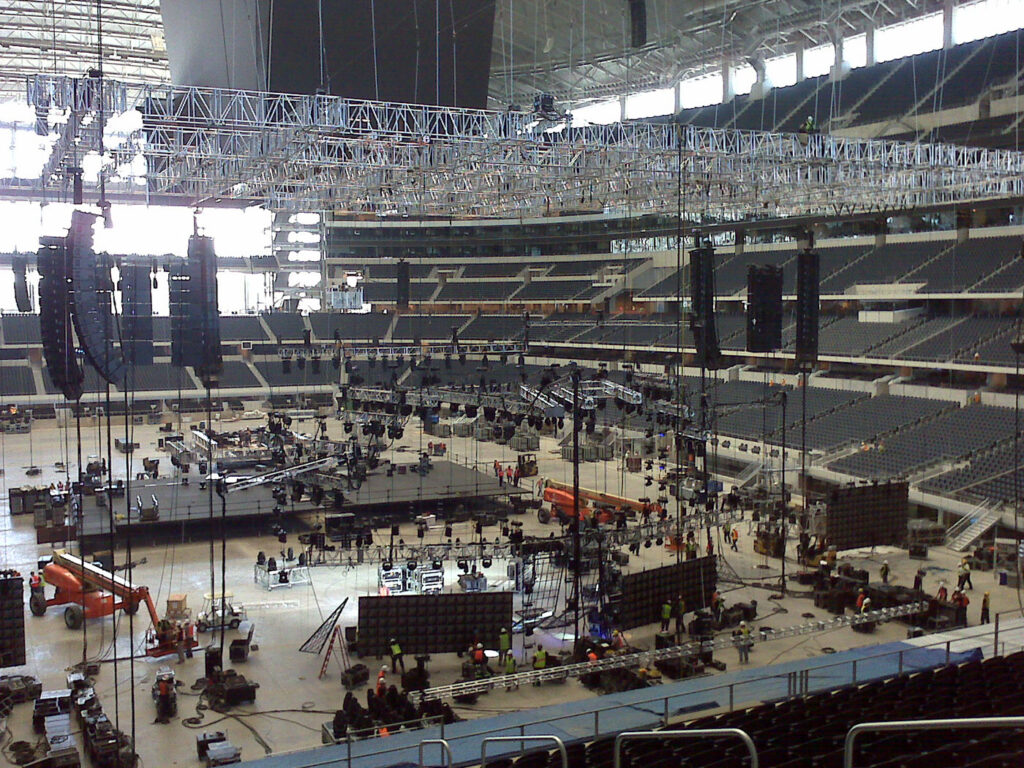
The term lighting truss is a generic term used for systems that support elevated equipment in live entertainment environments. This includes lighting fixtures, speakers, video displays, projectors, special effects equipment, power distribution, and more.
Truss systems can range from simple 10-foot spans supported by stage stands to large stadium systems supported by multiple hoists and control systems. Regardless of size, the same safety principles apply.
General Safety
Little things can mean a lot. The smallest detail, when overlooked, can contribute to catastrophic failure. The two primary safety concerns are weight capacity and stability. Regardless of the size of the system, these two factors are the most important.
Keep in mind that the weight load and system capacity are determined not only by the static weight of the load, but also by the lateral placement of the individual incremental loads. The capacity of the truss will be reduced the farther you are from vertical support.
The calculations for horizontal “non-balanced” loads can be mathematically difficult, which we will not go into here. If you’re going to hang a few PAR cans on a 10 ft, stage-supported truss, you’ll probably be OK. Anything more than that—consult a professional engineer or certified rigger to perform your load calculations. It may sound expensive to hire a professional, but it’s far less costly than a catastrophic failure that could injure or kill someone (or multiple people), as well as cause significant equipment damage.
On very small systems, there may be no need to employ a professional engineer. However, you will need to know the weight capacity of the system and the calculated load (weight) it is expected to support. Remember, floor-supported systems are only as good as the surface on which they are installed. The supporting surface must be flat, level, and stable.
Fixed Systems
Fixed truss systems are often found in auditoriums, studios, and similar environments. These may be attached to the building or supported independently. Some smaller systems use pipe grids instead of truss, which can be more forgiving due to closer support spacing. However, weight limits still apply.
Moving Truss and Hoists
Large and medium-sized permanently and temporarily installed systems may employ electric chain hoists or cable winches to lift truss-mounted stage equipment into position. This is generally done directly over the stage performance area and sometimes over the audience area. This allows the truss to be loaded and wired on the floor, then raised into position. System size may range from as few as two hoists to hundreds; typically, 10 to 50 hoists are used. Most large auditoriums and stadiums incorporate these types of systems. We will only be discussing chain hoist systems herein, although cable winches must comply with their own safety requirements. General safety precautions and procedures are similar for both systems.
It has become standard that “state-of-the-art” theatrical performances include moving truss during the show, which adds a “wow” factor to the presentation. Truss movement is controlled by automated control systems and requires specialized equipment with built-in safety apparatus and components, especially when the truss is over stage and/or audience areas. These systems require engineering approval and AHJ inspection.
When moving truss over an audience, additional safety considerations and regulatory requirements apply. In the United States, standards and enforcement are typically governed by the Authority Having Jurisdiction (AHJ), with guidance from organizations such as ANSI and ESTA. In Europe, stricter and more uniform standards (such as EN and DIN regulations) are often applied, particularly regarding dynamic loads and overhead movement above occupied areas. Regardless of location, any movement of truss over an audience must be carefully engineered, risk-assessed, and executed with redundant safety measures in place.
Control Systems
Types of control systems vary, from a simple hand-held up/down control for a single hoist to an automated computer control and monitoring system for multiple hoists or a SCADA
system for multiple Systems
Personnel Safety
Basic safety rules include:
- Never stand under a moving truss
- Enter truss areas only when secured
- Wear appropriate protective equipment
- Secure tools when working at height
- Use fall protection
Many incidents occur not because of equipment failure, but because safety procedures were not followed.
Load Cells
Load cells help monitor weight at each pick point, ensuring loads are balanced and within limits. These are often required on larger systems.
Wind Damage — Outdoor Shows
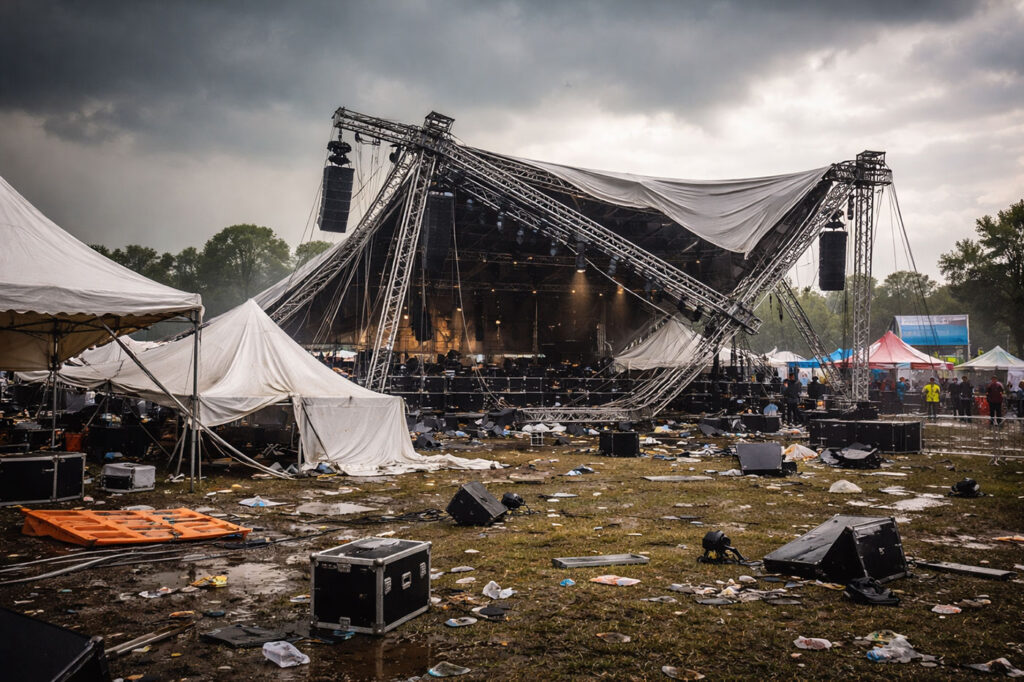
Due to the canopy’s light weight and large surface area, it doesn’t take much wind to lift the canopy, truss and anything else that’s attached to it. Something to think about.
It is a must that these types of systems and the design thereof be evaluated by an engineering firm that specializes in these types of systems to calculate the ballast and fastening requirements. As always, proper insurance must be provided. The photo below is AI generated to illustrate the potential dangers of wind-related truss and canopy failures at outdoor events; while not depicting a specific incident, it reflects conditions similar to those that have, in real-world situations, led to serious injuries and, tragically, loss of life.
Something to Think About
A fully loaded B-52 bomber weighs about 265,000 pounds and still gets off the ground because of the relationship between weight and surface area. A fabric canopy attached to a lightweight truss system has very little weight and a very large surface area, which means it does not take much wind to lift the canopy, the truss, and anything attached to it. Outdoor truss and canopy systems should always be evaluated by an engineering firm to determine proper ballast and fastening requirements, and proper insurance should always be provided.
Electrical Safety
There are times when truss systems may become “energized.” This may be due to stray building voltages, defective equipment, motor leakage current, and/or frayed or nicked power cables.
Remember: Voltage is the difference in electrical potential between two points that are not electrically bonded together. If all conductive metal truss and apparatus, including the building steel, are bonded together, there is no voltage.
As an example, if a truss system becomes energized (due to an electrical fault) and it is not bonded to the grounded building steel, there is a difference in electrical potential (voltage) between the two points.
If you touch the building steel at the same time as you touch the truss, you get ZAPPED.
Always use a volt/ohm meter (VOM) to verify that there are zero ohms from the truss to the building steel and that there is no voltage between the two. If significant voltage is detected, the root cause must be determined and corrected.
The magnitude of the “shock” may range from a small tingle to electrocution. In many cases, when a shock is received, it’s not necessarily the electricity that injures or kills—it’s the fall from high elevations due to the loss of muscle control
Inspections
- Check local requirements for inspections and approvals. Larger systems almost always require them.
- Do not wait until the last minute, as authorities can shut down a show if requirements are not met.
Conclusion
In the live entertainment industry, most truss accidents are not caused by one major mistake. They are usually the result of several small mistakes that were overlooked or ignored. The small details matter, and when multiple small problems come together, the result can be equipment damage, injury, or worse. So, remember to do the following:
Know your weight compacity
This includes the truss itself, chain hoists, spans, and support structures. Many people assume that if it went up last time, it will be fine this time. That is not always true. Every setup is different and loads change from show to show.
Balance your Loads
It is not just the total weight that matters, but where the weight is placed. Loads placed far from support points reduce the capacity of the truss. An unbalanced truss can overload one section or one hoist even if the total weight is within limits.
Do Not Stand Under a Moving Truss
This happens more often than it should. No one should ever stand under a moving truss. Equipment can fail, rigging can slip, and loads can shift. Always wait until the truss is secured and locked in position before entering the area.
Secure all equipment
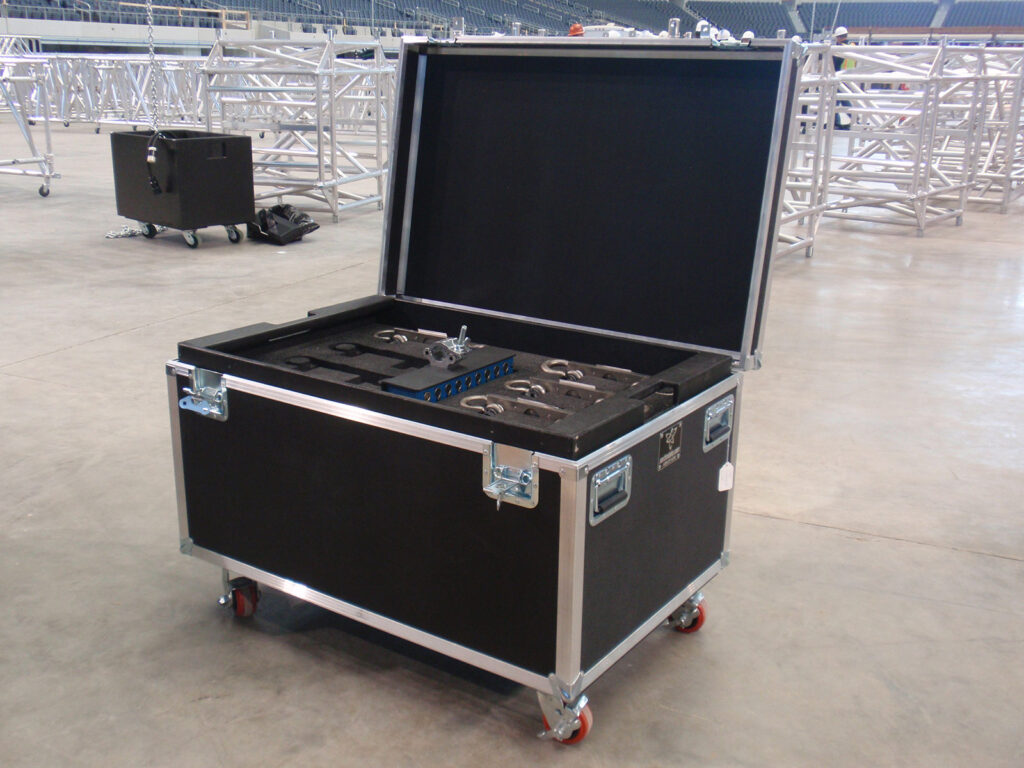
Every lighting fixture, speaker, or piece of equipment hung from truss should have a secondary safety cable. Clamps can fail, bolts can loosen, and mistakes happen. The safety cable is the last line of defense.
Ensure Proper Grounding and Bonding
Truss systems can become energized due to faulty equipment, damaged cables, or stray voltage. If the truss is not properly bonded and grounded, there can be voltage between the truss and other metal structures. This can result in electric shock. Always verify bonding with a meter.
Always Have a Wind Plan for Outdoor Events
Wind is one of the biggest causes of outdoor truss failures, especially with fabric canopies. These structures can act like sails and lift entire truss systems off the ground if they are not properly ballasted and secured. Outdoor systems should always be engineered and have a wind plan.
Share the load
On multi hoist systems, the load must be shared evenly. If one hoist is carrying more load
than the others, it can become overloaded even though the total system weight is
acceptable. Load cells are often used to monitor this.
Don’t Build on Uneven Ground
Floor supported truss systems are only as good as the surface they are sitting on. Uneven ground, soft surfaces, or sloped floors can cause stands to shift or tip.
Welcome Inspections with Open Arms
Larger systems and outdoor systems often require engineering approval and inspection. Skipping this step can result in the system being shut down by authorities or, worse, an unsafe installation.
Communication is Key
Many accidents happen because someone did not know a truss was moving, someone entered a restricted area, or multiple people were operating equipment without coordination. Communication is a safety tool just like any piece of equipment.
Most truss accidents are not caused by equipment failure. They are caused by human error, poor planning, or overlooked details. Pay attention to the small things, follow basic safety procedures, and communicate with your crew. The goal is that everyone goes home at the end of the day.
Most failures are not caused by one major mistake, but by several small ones.
Pay attention to the details.
DISCLAIMER
This blog is intended to provide information to people in the live entertainment industry to enhance their technical knowledge and provide a better understanding of equipment safety related to truss systems. The opinions expressed here are personal interpretations. Always verify specifications to ensure equipment meets your requirements. Be mindful of vague specifications and less than reputable providers.
Information provided is for general guidance only. Specifications, configurations, and requirements may vary by application. Always consult a qualified professional before installation or use.
Motion Labs encourages questions, feedback, and suggestions for future topics.
About the author:
Jim Herrick, over 40 years’ experience in the electrical field. Licensed in the State of New Jersey as an Electrical Contractor (License #6748) and Electrical Inspector (License #7702). Of the 40 years’ experience, 30 of which included work in the theatrical industry, which also included electrical equipment design for major companies in the industry.