



What’s Really Protecting Your Gear?
A no-nonsense look at conditioners, UPSs, and surge protection
Line Conditioners and Filters
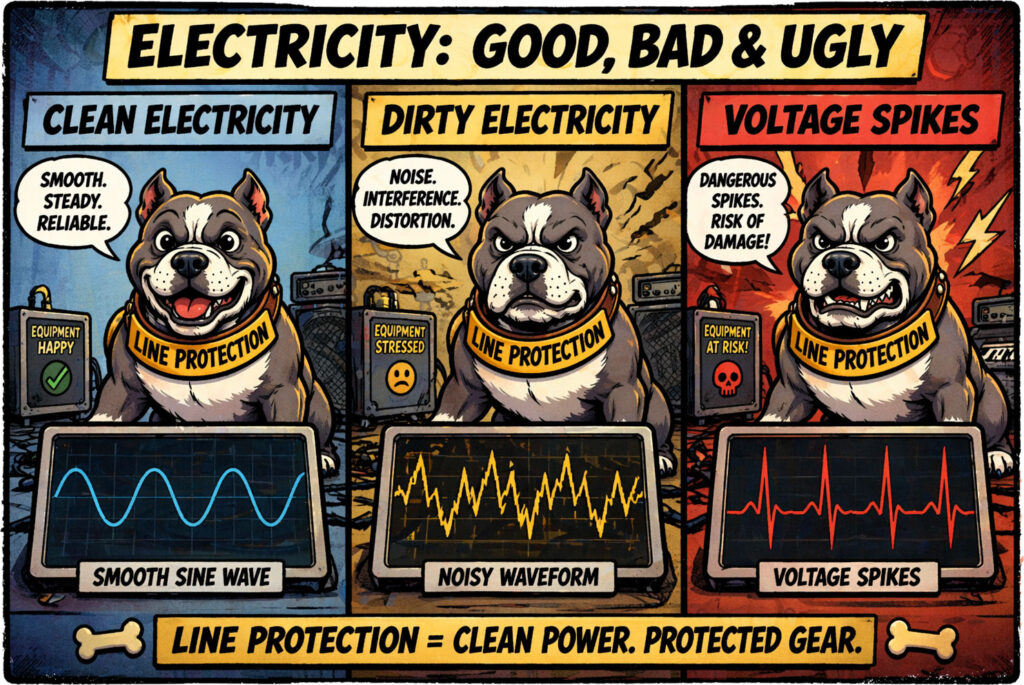
There is no qualifying definition of a line conditioner; it can mean almost anything. For sake of this article, let’s say a line conditioner refers to any device intended to clean incoming power by reducing noise, and limiting voltage transients. A common misconception is that line conditioners provide voltage regulation, which is usually not the case. Conditioners that do provide voltage regulation are available, but they are often expensive depending on capacity.
Modern power supplies in audio equipment can tolerate large variations in input voltage, so it is normally not a major concern.
Before purchasing this type of equipment, determine what you want it to do. Do you want to stabilize voltage, provide surge protection, or filter certain frequencies?
There is a lot of room for misleading claims when equipment manufacturers provide vague or unclear specifications, so do your homework.
In its simplest form, a capacitor and or an MOV costing less than one dollar can be considered a line conditioner. In some equipment, that is all there is.
TIP: Be cautious of vague or unclear specifications. Marketing claims can sometimes be misleading. A capacitor or MOV costing less than one dollar can technically qualify as a line conditioner. In some cases, that is all that is inside the box you are buying.
Surge Suppressors
This is one piece of gear that can absolutely save your system, when it is chosen correctly. Always stick with units listed by UL or another NRTL. If it is not listed, do not even consider it.
UL and the National Electrical Code break surge protection down into a few types:
- Type 1 – Installed on the line side of the service
- Type 2 – Installed on the load side of the service or at a separately derived system, like a transformer
- Type 3 – Installed at the branch circuit level. This is your typical surge strip or surge protected receptacle
- Type 4 – Component level devices used inside equipment during manufacturing For the sparkies in the room, surge devices generally fall into two camps:
Shunt mode – Diverts surge current, typically to ground or neutral, once a threshold voltage is exceeded. These commonly use MOVs, which wear out over time depending on how many hits they take
Series mode – Limits surge current by increasing impedance at certain voltages and frequencies. These do not degrade the same way MOVs do, but they are typically limited in how much current they can handle due to size and cost constraints
Both approaches have their place, and neither is a magic bullet. The key is matching the device to the application and not getting sold on marketing hype instead of real performance.
How do GFCIs work?
In a typical circuit, power comes from the source, through the load, then back to the source. This is basically a series circuit. As we all know (or should), current is the same throughout a series circuit; therefore, the current going to the load will be of the same magnitude as the current coming back from the load.
So… the power comes out of one prong on the GFCI outlet, through the load, then back to the other prong of the GFCI outlet. All is well, but what happens if some of the current does not return because of a ground fault or leakage? Well. the internal circuitry in the GFCI can detect this imbalance and shuts the power off.
Did you notice that I didn’t mention the connection of a ground wire? That’s because GFCIs do not require a ground connection to function. There are, however, several other reasons to have a ground connected to a GFCI outlet, but not for its tripping functionality.
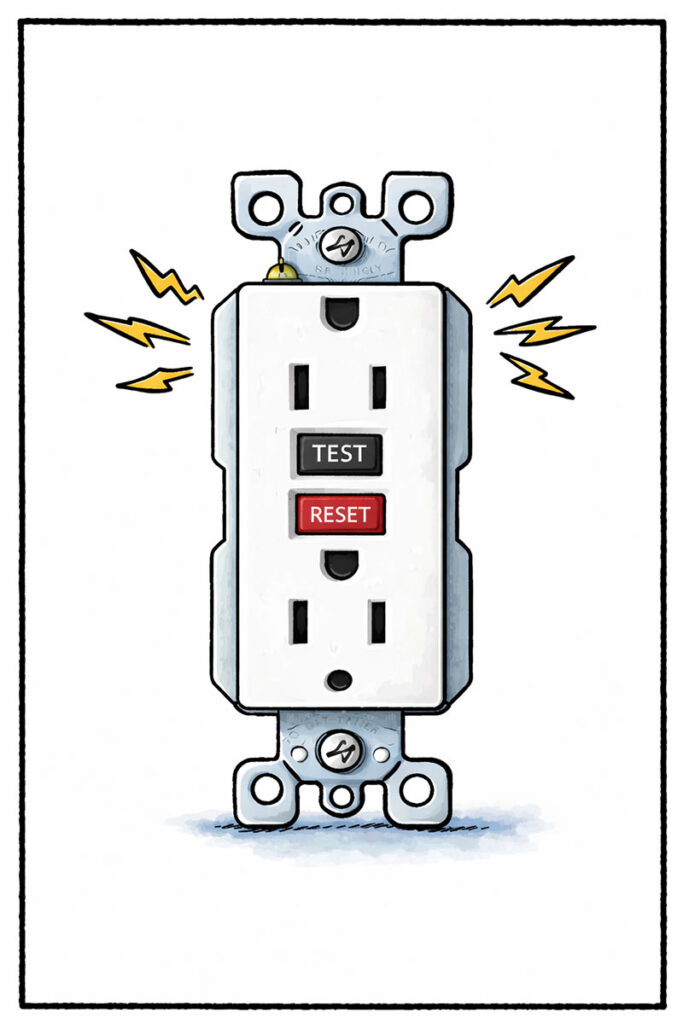
Typical branch circuit breakers trip at 15 or 20 amps (you may be dead by then). GFCIs trip at 5 mA (0.005 amps). 50 mA (0.050 amps) can be lethal. Because of the low tripping point of GFCIs, they can’t be installed everywhere. Nuisance tripping is a definite problem. The 2014 NEC, Article 520, which pertains to theaters, does not require GFCIs on stage for that reason. However, a proper grounding scheme is of the utmost importance.
Something To Think About
A typical human can begin to lose muscle control at around 10 milliamps, and at 50 milliamps the effects can be fatal. Compare that to standard circuit breakers that trip at 15 or 20 amps. The devices protecting your equipment operate at levels thousands of times higher than what can harm a person.
UPS (Uninterruptible Power Supply)
UPSs, commonly referred to as battery backups, are essential for computer systems and, in some cases, computer-controlled theatrical equipment, such as programmable stage lighting controls, sophisticated audio systems, and other computer-controlled equipment. The normal intent is to provide power long enough to accomplish an orderly shutdown of equipment and/or provide time to “save” data and perhaps allow enough time for a generator to start up and stabilize. UPSs are rarely used for continuous, long-term operations of equipment during a power failure.
The length of time that a UPS will adequately function is based on two things: (1) the wattage of the connected load and (2) the battery rating in “amp-hours.”
There are two basic types:
Line-interactive, which provides power “all the time.” The batteries are constantly recharging, being inverted to AC, and outputting power to the load. These usually provide voltage regulation and stability but are expensive.
The other type only outputs upon a power failure (you probably have one of these on your computer). They are relatively inexpensive and are all you need in most cases.
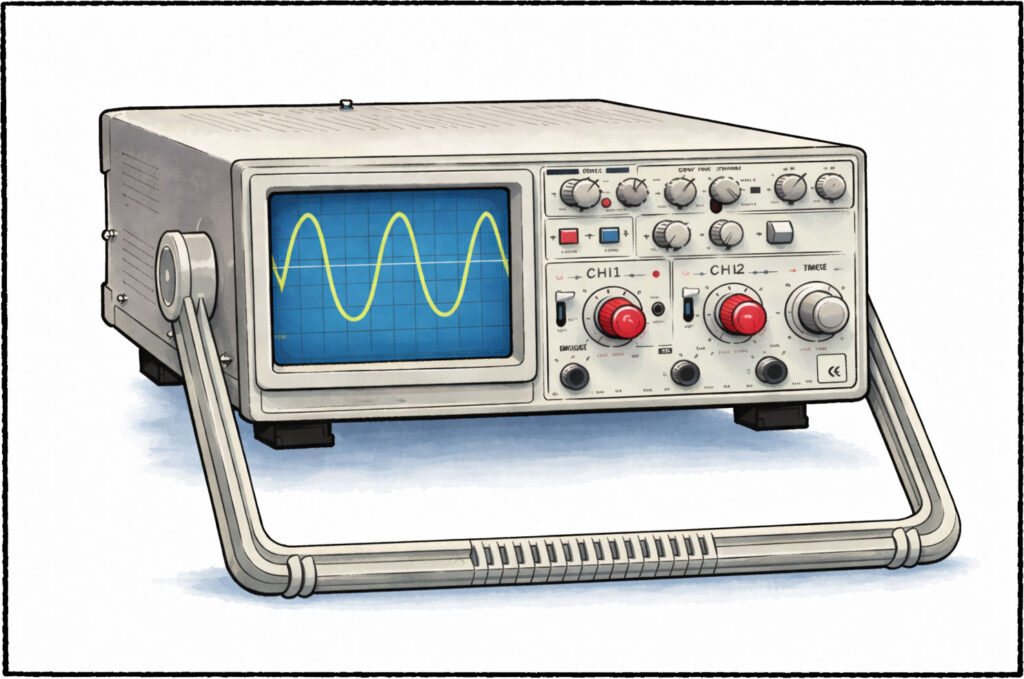
One thing to look out for is the sine wave on the battery output inverter circuit. In most inexpensive versions, the output sine wave is not “sinusoidal,” but rather a “modified square wave” (like stair steps). Some equipment will not work, or will work poorly, with this type of output.
Something To Think About
If your system shuts down during a power event, it is often not the loss of power that causes damage but how the system responds to it. Controlled shutdowns and proper protection can prevent costly failures.
Transformers
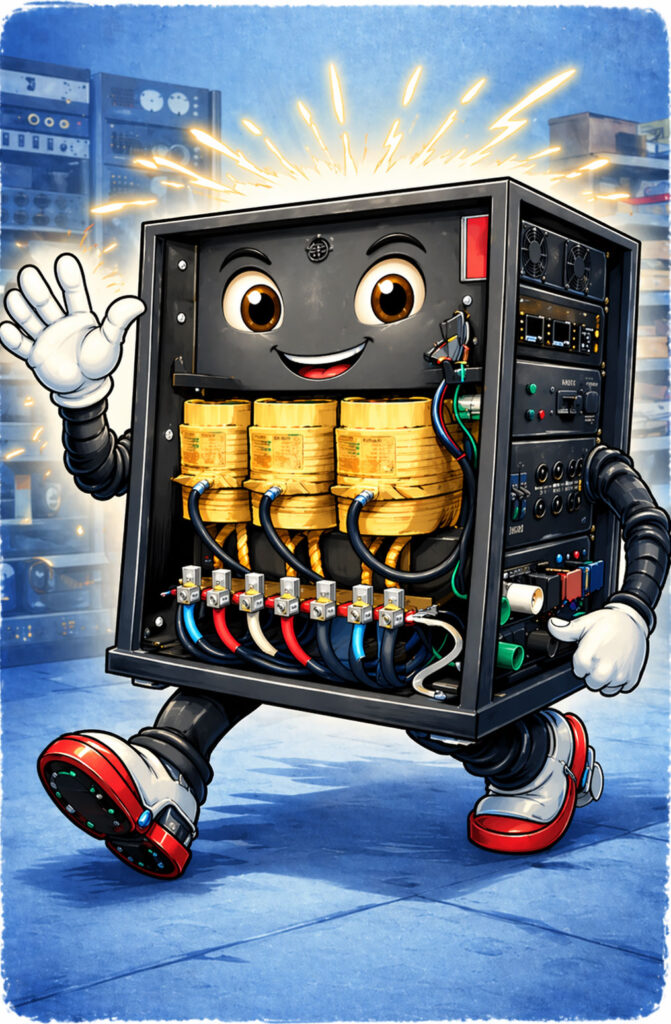
Figure 5 The Happy Transformer
Transformers adjust voltage levels to match equipment requirements. Most are isolation types. Some provide voltage change, while others provide isolation only.
Transformers cannot correct voltage fluctuations, change frequency, create additional power, or convert single phase to three phase.
Conclusion
The opinion expressed herein is only a personal interpretation and/or opinion. Check specific product specifications to verify that the equipment you wish to purchase meets the requirements you have in mind.
Be mindful of vague specifications and that there are equipment providers that are less than reputable.
Motion Labs is here to help.
We encourage you to ask questions, provide constructive criticism, and suggest subjects for future blogs.
Remember some of the subject matter may be argumentative in nature. If you disagree or need clarification, let us know.
Thanks:
Jim Herrick
DISCLAIMER
This blog is intended to provide information to people in the live entertainment industry to enhance their technical knowledge and provide a better understanding of equipment safety related to truss systems.
The opinions expressed here are personal interpretations. Always verify specifications to ensure equipment meets your requirements. Be mindful of vague specifications and less than reputable providers.
Information provided is for general guidance only. Specifications, configurations, and requirements may vary by application. Always consult a qualified professional before installation or use
Motion Labs encourages questions, feedback, and suggestions for future topics.
About the author:
Jim Herrick, over 40 years’ experience in the electrical field. Licensed in the State of New Jersey as an Electrical Contractor (License #6748) and Electrical Inspector (License #7702). Of the 40 years’ experience, 30 of which included work in the theatrical industry, which also included electrical equipment design for major companies in the industry.